
“Justice for Bandit (แบนดิท)”
Complete Presentation
I’m calling this piece “Justice for Bandit”, but while we’re at it, justice for Drag Race Thailand, which seems constantly to get overlooked when people talk about the series. Despite everyone having forgotten this, the first plus-size winner of Drag Race was crowned queen of Drag Race Thailand season one (nearly three years before Lawrence Chaney won), and the first trans girl to win Drag Race was crowned queen of Drag Race Thailand season two (two and a half years before Kylie Sonique Love was crowned).
One of the reasons that Thailand is constantly overlooked is that the original two seasons of Thailand are much messier than the other Drag Race franchises. Although the new season of the show, season three—with Pangina Heals as the host—follows the format of franchises like Canada’s Drag Race, Drag Race España, and Drag Race Belgique, the original two seasons were much more unpredictable—and I mean that in a good way. Most episodes of Thailand season two involved a mini challenge, a maxi challenge, and a runway challenge that was also a separate design challenge with queens still finishing the looks in the workroom.
And in a reversal of the values of the flagship US program (where the runway almost doesn’t matter at all), the winner of the maxi challenge might still find herself in the bottom because on Thailand seasons one and two, the only thing that mattered was the runway. This happened repeatedly on season two, most notably on episode eight when the winner of the Snatch Game maxi challenge, Tormai, then went home after being placed in the bottom and losing the lipsync.
In short, Drag Race Thailand is a hidden gem with wild challenges, incredible designs, and truly iconic queens, and it needs to be watched by more Drag Race fans.
Rigga Morris

 Thailand season two saw a particular amount of added drama when the judges asked Filipina queen Mocha Diva to sashay away. Mocha Diva took a scorched earth approach to her elimination, accused competitor Miss Gimhuay of cheating, and then both queens ended up eliminated. Two episodes later, after sending home their Snatch Game winner, Drag Race Thailand brought back two different eliminated queens to the competition, turning the whole season on its head. This was a slap in the face to the current top four, and it created quite a furor among the show’s viewers. But always consistent, with exquisite runways and excellent performances in the challenges, Bandit persevered, appearing on every episode of the show but not competing in the finale.
By the time production brought back two eliminated queens Bandit had already seen the writing on the wall. She knew the judges were just not living for her work, and Bandit more than once said in the confessional that she doubted she would make it to the top three.
The main issue seemed to be that co-host Pangina Heals was extremely hard on Bandit’s runways, and because of the way the judges’ votes were counted on seasons one and two, this mattered a lot. The judges all said of her Elephant runway, for example, that it was perfection, that it moved them, that the details were exquisite, that they were blown away. Pangina said, “This is stunning, but this is the level that I expect Bandit to be. I’m not wowed by her. I want to be surprised by her.” At one point—actually for this lingerie–reveal runway—Pangina’s criticism was: “it started at wow and stayed there, and I want more levels.” In her confessional that day Bandit said, “Did my heart ache? It’s been aching for a long time. That’s why I’m saying I might not make it to the top 3. Even though it hurts me, I’m not gonna give up.”
She was right. The final top three included two of the returning queens rather than those who had been there the whole time, and it looked very strange indeed when Bandit and Vanda Miss Joaquim were asked to leave in a second double elimination just before the finale. Unaccountably, Bandit was placed in the bottom for her White Elephant-themed runway which, as we’ve discussed, was actual perfection. It was also her very first time lipsyncing in the season, but she went home anyway.
แบนดิท
 Bandit was a fashion designer, and had his own clothing line, Bandit by Bandit, which you can see in one of his confessional looks on the show. Bandit, apparently, also designed many outfits for Pangina Heals. Bandit was rumored to be on last summer’s absurd Global All Stars season one, and since he was an English speaker, this made perfect sense, but this turned out to be only a dream; no Thai queen appeared on that season at all. Unfortunately, we won’t be seeing Bandit on tv again. He took his own life on December 26, 2023, at the age of 38.
Bandit’s death hit me particularly hard for reasons I don’t totally understand. Maybe it was how underappreciated she was on her season; maybe it was that it happened at Christmas—a holiday which seems to demand particular sacrifices from queer people—perhaps my response was bound up with residual emotion from my own mother’s passing the month before. But suicide, as many have pointed out, is a particularly queer death, something our world perhaps ought to have outgrown, that should no longer happen, but which still happens all too frequently, and I find this emotionally difficult to manage.
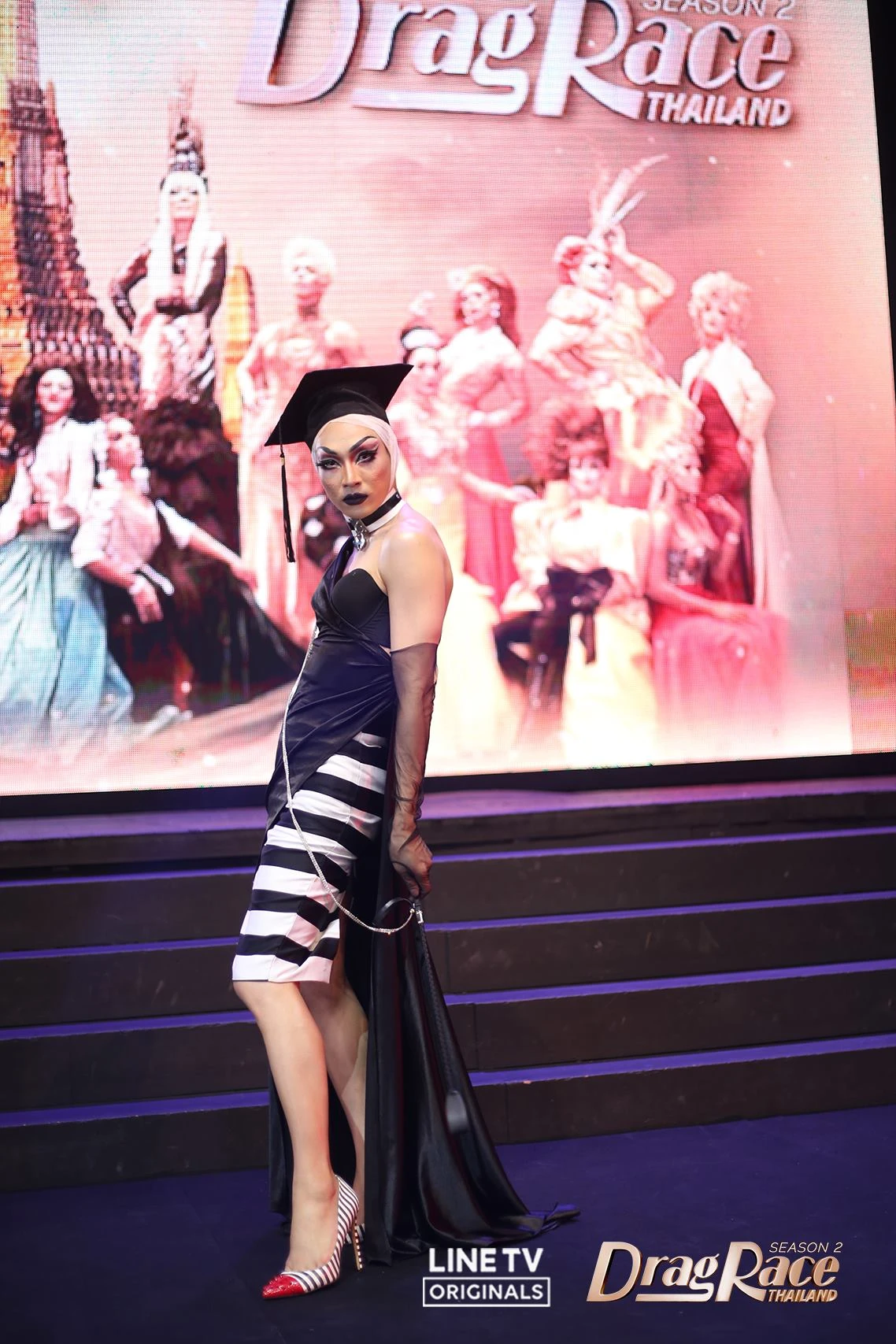
Bandit’s name derives from the Sanksrit word pundit (पण्डित)—probably from the word prana (wisdom)—which in Hindi, Urdu, and Thai became pandit (บัณฑิต) or—the obsolete form—bandit (แบนดิท) in Thai. In English this became our word pundit. The word in all of these languages means scholar or wise person. Bandit realized his given name meant something else in English and chose it as a drag name … but played on the original meaning with her reunion outfit, where she went in scholar drag.
In 2011 Bandit designed a men’s clothing line called The Man from the Venus. When I heard about this allusive name I was reminded instantly of the cross-dressing modernist playwright Rachilde, who called herself “homme de lettres” (man of letters) and penned the scandalous novel Monsieur Vénus. Suicide held an important place in the modernist avant-garde of which Rachilde was such an important part: characters in her novels and plays frequently wrestle with the Death drive and often put themselves in danger. Rachilde even once referred to her own marriage to Alfred Vallette as a suicide. But the author of Monsieur Vénus didn’t mean that being married killed her; she meant something more like one life ends and another one begins. I like to think of Bandit’s death now more like that—not the end as such, but just the end of one thing and the beginning of something new for him. Either way, there is no queen who I miss more, or who I wish I could spend time with. Bandit, here’s to you.