
“Early Modern Performativity and Imogen Says Nothing”
Opening Section
Aditi Brennan Kapil’s 2017 play Imogen Says Nothing takes as its central problem the place of women in Shakespeare. Like other plays from this theatrical moment—Morgan Lloyd Malcolm’s Emilia (2018) and Jessica B. Hill’s The Dark Lady (2020), to take two examples—Imogen is set in Early Modern England and attempts to displace Shakespeare from his usual central place in any narrative about theatre in Early Modern London. Indeed, the central idea behind the writing of all these plays is to respond to the androcentrism that inheres when we focus on Shakespeare. The central difference with Imogen Says Nothing, however, is Kapil’s insistent focus on lacunae. It isn’t only that nothing appears in the title, pointing toward both absence and silence, Kapil also consistently turns her attention to what we don’t know or can’t know, toward the ways that the archive renders some people silent or, rather the way that writing actively works to produce so many of history’s silences.
The play begins with the following question asked by an as-yet-unnamed woman:
They told me London is where lands are drawn,
where printers tattoo Saxton’s England ’pon
the parchment of history. That sturdy skin
that withstands any but the sharpest tool.
A blade, a shard of glass, what would it take?
To edit ink burned deep into the past.
To re-mix history.
Chew it, spit it out, step in.
From the first scene, then, Kapil introduces the subject matter of Imogen as primarily about questions of historiography. For this ASTR working group on Early Modern Generative Acts, I want to consider the way Kapil uses the absences in the record as a tool for fabulation, for the generation of a new view of Shakespeare, the Lord Chamberlain’s Men, and Early Modern writing. I want also to make an argument that merges the play’s focus on both bears and (the absence of) women, turning toward the potential of a trans politics embedded in the play and, as the play argues, perhaps embedded in the very structure of Early Modern theatrical performance.
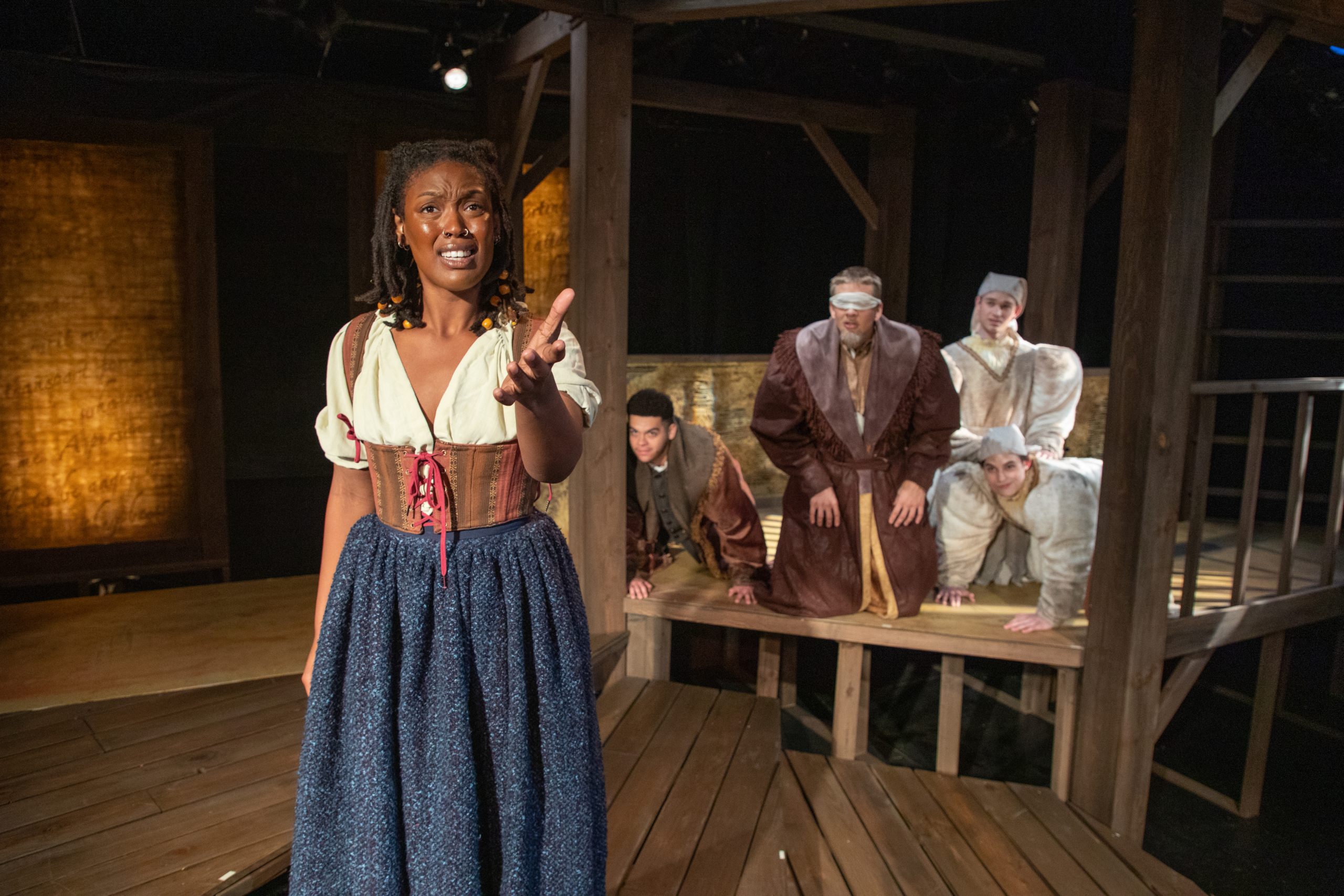
FSU School of Theatre, Imogen Says Nothing
It is not easy to describe Kapil’s show: it’s a backstage comedy about the first performance of Much Ado about Nothing at The Theatre; it’s also about a bear who has escaped from “Paradise,” a bear-baiting ring in the neighborhood of The Globe on the other side of the river; and it’s about ink—John Saxton’s map-making, Giles Alleyn’s lease on the land where The Theatre sat in Shoreditch, William Aspley’s quarto of Much Ado, and the compilation of the First Folio by Henry Condell and John Heminges. (Nothing if not maximalist, the play is subtitled The Annotated Life of Imogen of Messina, Last Sighted in the First Folio of William Shakespeare’s Much Adoe About Nothing.) Because one of the actors is severely hungover, the bear, Imogen, who is “passing” (Kapil’s word) as a human, winds up onstage for Much Ado’s premiere; she then finds herself in ink in published editions of the play, although Shakespeare has given her no lines to speak. In Shakespeare’s oeuvre there is also, of course, another very famous bear onstage in pursuit in The Winter’s Tale, and Kapil uses the (possible) performance of Much Ado and Winter’s Tale together at the wedding of Princess Elizabeth Stuart and Frederick V Elector Palatine of Bohemia in 1613 to bring the absence of women and the presence of bears together in Imogen’s penultimate scene.
In Kapil’s words, the play is “a revisionist hijacking of a chunk of the literary canon,” but it turns its attention away from those in whom theatre historian have traditionally found interest—Shakespeare, the actors, and their fellows—and toward the women missing from these stories as well as the bears who lived next door to the Globe and the Rose, imprisoned, enslaved, and forced to perform classical tragedies for the same audiences who attended Julius Caesar. In Imogen, the missing women remain missing—the play is fascinated by their absence—but Imogen’s focus on bears opens a series of other (feminist) explorations, and in addition to the backstage cast of the Lord Chamberlain’s men—Condell, Heminges, Shakespeare, Richard Burbage, Alexander Cooke, Nicholas Tooley—the play boasts a cast of five imprisoned bears, including some whose names were written down, Harry Hunks and Ned Whiting.
Imogen Says Nothing is a play about oppression. The play purposely links the bears to incarcerated people, the Middle Passage, feminism, transgender politics, queerness, and fatness, to name only the most obvious groups for whom we might read the bears as signifiers. Imogen Says Nothing is also firmly rooted in the material conditions of the Shakespearean canon rather than mere textual play. This is no ursine riff on Much Ado or Winter’s Tale; it’s a play that interrogates the materiality of history by looking more closely at ink on paper, stains on parchment, and the drawing and labeling of maps. In this way, Imogen Says Nothing “is part of a critical movement that,” as Tiffany Stern says in the prologue to her book Making Shakespeare, “concentrates not on ‘Shakespeare’ the individual author but on the collaborative, multilayered, material, historical world that fashioned the Shakespeare canon.” From the perspective of marginalized groups, Imogen begins by asking what it would take to re-mix these histories, to chew them, spit them out, and step into them. As the passage quoted above makes clear, Kapil sees this as material work that needs to be done on the canon.
